What earns the 7.5.
Five equally weighted categories assess documented equipment and buyer fit. No measured speed, handling, durability, runtime or reliability scores are assigned.
Build / buyer fit
8.5/10The space frame, inboard springs and trailing arms give the assembly its own identity.
Documented equipment
7.5/10Body and 540 motor included; radio and power equipment remain extra.
Setup / adjustment
7.5/10The model-specific manual explains the unusual mechanism; ESC regional ambiguity needs confirmation.
Service understanding
7.5/10Official chassis views and instructions make the exposed mechanism understandable.
Complete-purchase value
6.5/10Manufacturer $313 reference and separate controls require an honest whole-basket quote.
The buying case: The Frog (2005)
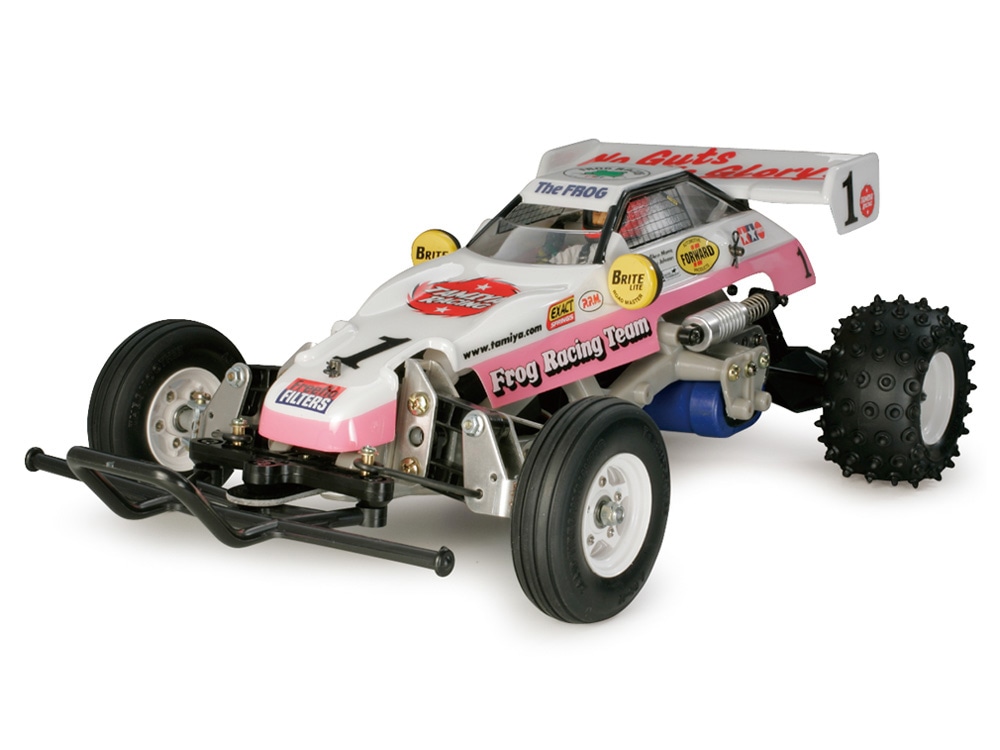
The Frog makes most sense for a returning builder who wants to understand an unusual old buggy, then drive it gently enough to keep enjoying the thing they built. Its space frame, inboard front springs and laid-down rear dampers make the assembly interesting before a battery ever turns a wheel. The reservation is equally clear: this is a revived design with a modern electronics shopping list, not an assembled contemporary racing buggy. Buy 58354 for the Frog experience. If your real priority is joining a current competitive buggy class, start with that class instead.
This review identifies the 2005 re-release body-inclusive kit and Amazon’s TAM58354 part number. That TAM prefix is a distributor identity for the manufacturer’s 58354, not evidence of a different chassis. The verified listing explicitly asks for a speed controller; older regional descriptions show bundled controllers. We use the conservative completion basket and require the seller’s contents to settle that purchase detail. The kit supplies the body and running hardware, but you still build, finish and equip the vehicle. It belongs in a complete-car kit archive because it includes its own car body, rather than being the bare frame suggested by some search titles.
The attractive purchase is therefore a mechanical project with a driving reward. Our assessment is aimed at somebody who welcomes that sequence. It is not a measured speed or durability score.
Sources: Manufacturer ↗ · Manufacturer manual / specification ↗
The complete package: The Frog (2005)
The supplied 540 motor, polycarbonate body, wheels and chassis components are the core of the Frog kit. Radio transmitter, receiver, steering servo, drive battery and charger belong on the separate shopping list. The Amazon product features also place the speed controller on that list. Do not let an old picture of a mechanical controller or an outdated bundled-ESC statement decide what you order today. Ask for the actual current box specification if the seller describes a regional electronics package.
A useful build sequence is to read the gearbox and suspension steps before opening every bag. The Frog’s layout rewards keeping small hardware organized by assembly stage. Build the rear transmission on a clean tray, identify each shaft and spacer, and confirm the differential turns freely before its cover closes. Check the front radius arms and spring arrangement against the drawing; the fact that they look different from a modern buggy is the point of this purchase, not a reason to substitute an improvised assembly order.
Budget for body finishing as well as electronics. The manufacturer’s product photograph shows a finished model. Paint appropriate for polycarbonate belongs on the shell; the driver and molded details require suitable finishing materials for their own plastics. Masking and decal work are part of the ownership package. A buyer who dislikes those jobs should price an RTR alternative before interpreting the kit price as a saving.
Sources: Manufacturer ↗ · Manufacturer manual / specification ↗
Drivetrain and power: The Frog (2005)
Power goes to the rear wheels through a sealed gearbox and differential. A differential lets the outside wheel travel farther through a corner than the inside wheel. It does not behave like a locked crawler axle or the spool in a dedicated drift car. The practical starting point is ordinary RWD buggy driving: get the car pointed where you want it, then add power progressively as the available grip allows.
Tamiya retained the basic Frog arrangement while updating the rear drive joints to dogbones. That gives the builder a concrete inspection task. Confirm that the shafts seat correctly throughout suspension travel and that the protective boots fit as the manual shows. A shaft that binds because the suspension was assembled incorrectly is not a problem cured by a hotter motor. The three available gear arrangements are a mechanical feature to learn, rather than three promises about top speed. Keep the first build at the documented baseline.
The included RS-540 type motor is brushed. Select an ESC compatible with that motor, the chosen battery chemistry and the intended pack voltage. A brushless-capable controller elsewhere in a retailer description does not make the supplied motor brushless. My first spending priority would be a coherent standard power system and free-running transmission. Replacing everything with more powerful electronics before the first drive makes it harder to discover whether the car was assembled and adjusted correctly in the first place.
Sources: Manufacturer ↗ · Manufacturer manual / specification ↗
Radio and setup: The Frog (2005)
You provide the radio system, so the Frog does not arrive with a named modern transmitter or a documented factory gyro package. That is a buying advantage if you already own suitable equipment and a complication if this is your first hobby-grade car. Count transmitter and receiver together; a loose transmitter without a compatible receiver does not complete the vehicle. Check that the receiver, controller and their wiring fit within the available frame space before mounting them permanently.
With the car supported and the driven wheels clear, follow the radio and ESC instructions to establish neutral positions, correct steering direction and throttle calibration. Use a restrained initial throttle setting if your transmitter offers one, but do not assume a particular percentage or training mode is included with the kit. Those functions depend on the equipment you choose. Set the car down only after the controls behave predictably and the wiring cannot reach moving suspension or the transmission.
An attributable Tamiyaclub build by NulnOilTycoon describes selecting more compact electronics for the Frog’s relatively cramped frame. That is an owner’s modified build, not our test or a requirement to copy the expensive radio and servo selected there. Its useful lesson is packaging: electronics dimensions and wire routing matter alongside price. I would lay the parts in position before applying tape, leaving enough access to disconnect the battery without pulling on the receiver leads.
Sources: Manufacturer ↗ · Manufacturer manual / specification ↗ · Independent coverage ↗
Steering and suspension: The Frog (2005)
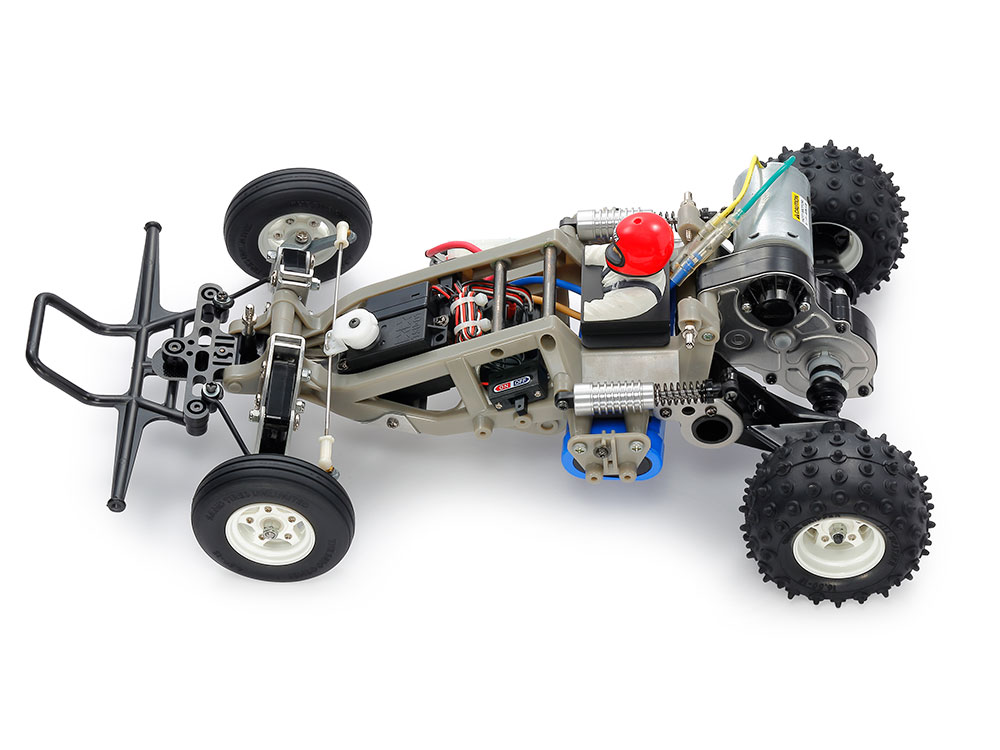
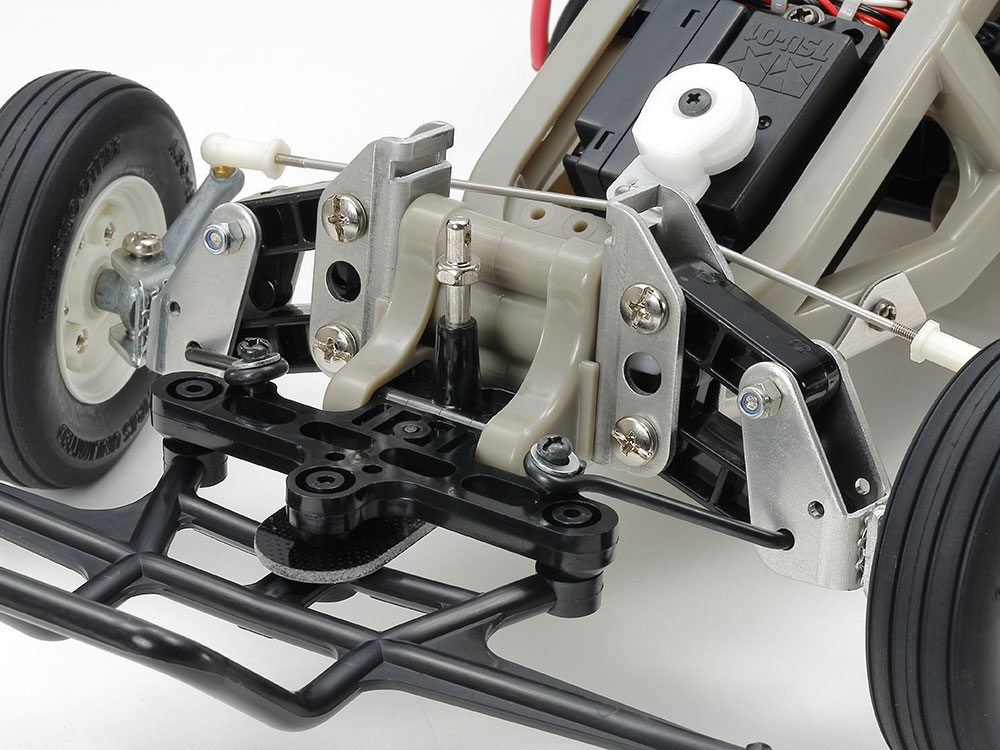
The front suspension uses double wishbones, inboard springs and steel radius arms; the rear uses trailing arms with horizontal oil dampers. This is substantially more interesting to assemble than treating the Frog as a simple nostalgia shell over a generic tub. It also means troubleshooting needs to follow the real mechanism. Compare left and right movement with the servo disconnected before deciding that a steering symptom needs an electronic correction.
Choose a servo that fits the specified mount and connect the correct servo-saver parts for its output spline. Center the servo electronically before fastening the horn. Then work through steering travel slowly, looking for a tie rod meeting the frame or a servo continuing to push after a mechanical stop. Increasing the transmitter’s steering setting cannot create clearance that the hardware does not have. A small amount of deliberate setup now protects your chosen servo from fighting the chassis later.
For the rear dampers, consistent assembly is more useful than selecting an exotic oil by guesswork. Follow the fill and sealing instructions, compare the two units, and check that neither arm sticks. The re-release’s diaphragm-type rear damper arrangement is an identified manufacturer update. We have not measured its absorption, so we score the documented equipment and the learning opportunity rather than declaring a handling advantage. The first objective is a symmetrical baseline from which a real driving session can tell you what needs changing.
Sources: Manufacturer ↗ · Manufacturer manual / specification ↗
Where to drive: The Frog (2005)
The ribbed front tires and spiked rear tires identify this as an off-road buggy package. For the first runs I would choose compact dirt or another relatively even, unobstructed surface, with enough room to recover a turn. The manufacturer’s off-road claims should not be stretched into a promise about deep grass, broken construction rubble or repeated large jumps. A small wheel meeting a root or a stone can stop the car abruptly even when the rest of the ground looks welcoming.
RWD also makes throttle timing part of the lesson. Begin with broad circles and gentle direction changes instead of trying to reproduce a promotional jump. Notice whether the rear tires spin on loose material and whether the front end can still follow the chosen line. Those observations come from your particular surface and equipment; there is no universal tire or gearing setting established by this research-led review. Change the driving area before buying a drawer of hop-ups to solve an undefined problem.
After a dusty session, inspect the drive joints, suspension pivots and wheel bearings or bushings. A sealed gearbox reduces direct contamination paths, but it does not seal every exposed moving component. Remove debris carefully, check that the wheels turn freely, and keep cleaning products away from materials they can damage. I would reserve wet running until the chosen radio equipment and the manual’s maintenance requirements have been understood; this kit does not supply a blanket electronics waterproofing guarantee.
Sources: Manufacturer ↗ · Manufacturer manual / specification ↗
Body and service: The Frog (2005)
The low polycarbonate shell and pink-and-white presentation are central to the Frog’s identity. They also leave a lot of the interesting frame visible. The official photographs show both a completed car and the chassis beneath it, making this an unusually satisfying model to inspect while building. Keep the finished shell as a removable working body; wiring or decorative additions that prevent easy removal trade everyday service access for appearance.
Mark and trim the shell using the supplied instructions, check it against the chassis before painting, and preserve clearance around tires and suspension. Paint on the wrong side or excessive trimming is expensive to undo. If reproducing the box scheme matters to you, map the masking sequence before spraying. If a personal color scheme is the attraction, the same fit checks still apply. Original decoration does not excuse a wheel rubbing the body at full steering lock.
Access is good enough to understand the transmission and front mechanism visually, but the frame is not a huge open electronics tray. Keep photographs of your wiring and mounting choices, particularly if you later remove the receiver or controller. The named community build is useful because it documents that these choices are a genuine part of building a Frog. It does not establish that every modification improves the stock car. I would complete and photograph a working baseline before ordering alternative frame colors, hubs or a second body.
Sources: Manufacturer ↗ · Manufacturer manual / specification ↗
Startup basket: The Frog (2005)
Tamiya USA’s dated manufacturer MSRP reference is $313 for the complete kit. It is a vehicle-only comparison, not the cost of a running Frog. The Amazon link independently identifies TAM58354 and shows an expiring commercial offer when available; that live amount is not frozen into this article. Before purchasing, compare the actual seller’s current contents and price, particularly the ESC. The distinction matters because regional box equipment and a lower seller offer can both change the shopping decision without changing the manufacturer’s published reference.
The essential basket is kit, compatible brushed ESC if absent, radio with receiver, suitable steering servo, drive battery, matching charger, transmitter cells, body paint and basic assembly tools. The checked evidence does not give current prices for every one of those choices, so this article does not invent a total. That is more honest than adding a token electronics allowance that may not fit the frame or support the pack you already own. Write down the required pieces and price the exact parts you intend to use.
For a returning owner, compatible existing equipment can improve the case dramatically. Inspect it rather than assuming a decades-old pack, damaged connector or unmatched receiver is useful. For a new owner, ask a hobby shop to quote the complete standard setup and clarify which ESC is inside the current box. I would keep cosmetic options outside that first quote. If the result approaches the cost of a contemporary assembled buggy, decide whether the Frog build itself is the value you wanted to buy.
| Item | Included / extra | Price basis |
|---|---|---|
| Reviewed vehicle | Kit/car only | $313.00 · stated dated reference |
| Motor | RS-540 type brushed · included | Included/extra as described |
| ESC | Separate in verified Amazon features; regional bundles vary | Confirm regional box; price any missing controller separately |
| Radio / servo | 2-channel transmitter/receiver + steering servo · extra | Extra; quote exact components |
| Drive power | Suitable 7.2 V pack · extra | Extra; quote exact pack and charger |
| Tools / finishing / transmitter cells | As required by exact manuals | Price required items separately |
Sources: Manufacturer ↗ · Manufacturer manual / specification ↗ · Manufacturer price reference ↗
Real alternatives: The Frog (2005)
The Tamiya Hornet is a complete body-inclusive classic kit with a simpler rolling rear axle layout and supplied 540 motor. Choose it when the Hornet identity matters more than the Frog’s space frame and independent rear suspension. It still asks for completion equipment and body finishing. These are different build experiences, not interchangeable shells or a measured ranking of their handling.
The Fighter NXGEN DT-04 is another complete-car kit worth comparing when you want beginner-friendly contemporary suspension equipment and a route toward suitable beginner racing. Its oil dampers and selectable wheelbases address a different brief from restoring an early-eighties design. Check your venue’s rules before buying either car for organized competition. A manufacturer’s racing heritage does not prove current eligibility, and our archive does not turn an old car into a modern race-class recommendation.
The BBX is the more ambitious scale-buggy build, with a cage, body panels, ball differential and a separate motor/electronics purchase. It is a credible comparison if the engineering project is what draws you to the Frog. Price the completion basket rather than comparing kit tags alone. I would select the Frog when its unusual front springs and low space frame are the reason for the purchase; the BBX when a modern scale buggy is the desired workshop project; and the Fighter when a first functional build matters more than a specific historical silhouette.
Sources: Manufacturer ↗ · Manufacturer manual / specification ↗
Buying verdict: The Frog (2005)
For the returning vintage-buggy builder, the Frog’s strongest argument is mechanical personality that survives the re-release. The supplied body and motor establish a recognizable project, while the suspension and transmission give you real things to understand during assembly. The main reservations are completion cost, regional ESC ambiguity and the risk of expecting modern competitive performance from a car bought chiefly for its history.
Our five equally weighted editorial categories assess build interest, documented equipment, setup clarity, service understanding and complete-purchase value. They do not measure grip, speed, crash resistance or long-term reliability. The independent material here describes an owner’s modified build, so it supplies context about fitting equipment without becoming evidence that the stock kit ran a particular way. Manufacturer photos likewise show equipment and construction, not our testing.
I would buy 58354 for somebody who can describe why they want a Frog beyond its price. Budget the controller and radio properly, enjoy the body work, and begin with the standard gearbox arrangement on forgiving ground. I would skip it for somebody who needs an immediately running car, dislikes finishing a clear shell or wants a platform specified by a current racing club. On those conditions the decision is straightforward: the Frog is a compelling classic to build and understand, provided you let that purpose set your expectations for the first drive.
Know exactly what you’re ordering.
Published manufacturer specifications for model 58354. Conflicting figures are flagged rather than silently corrected.
| Exact model / SKU | Tamiya 58354 |
|---|---|
| Amazon ASIN | B000CBNRA2 · API verified |
| Scale / drivetrain | 1/10 · RWD |
| Purchase format | Body-inclusive assembly kit |
| Motor | RS-540 type brushed · included |
| Speed controller | Separate in verified Amazon features; regional bundles vary |
| Radio / steering servo | 2-channel transmitter/receiver + steering servo · extra |
| Drive battery / charging | Suitable 7.2 V pack · extra |
| Length / width / height | 410 × 240 × 145 mm |
| Wheelbase | English manufacturer page prints 1,020 mm; unresolved error, not used |
| Suspension | Front double wishbone/inboard springs; rear trailing arms/horizontal oil dampers |
| Tires / wheels | Front ribbed; rear spiked · 21/73 and 51/88 mm width/diameter |
| Gear arrangement | Three gear arrangements · follow manual baseline |
| Body | Body supplied · finishing per exact regional instructions |
| Specification caveat | Frog English page prints 1,020 mm wheelbase. No correction is invented. Amazon requires ESC; historical regional kits vary. |
Sources: Manufacturer ↗
The questions worth asking.
Does this exact model come ready to run?
No. It is a body-inclusive assembly kit. The body and chassis are supplied, but assembly, finishing and completion electronics remain part of the purchase.
What motor and controller are included?
RS-540 type brushed · included. Separate in verified Amazon features; regional bundles vary. Confirm the offered regional box before buying replacement electronics.
What do I need for the first session?
2-channel transmitter/receiver + steering servo · extra. Suitable 7.2 V pack · extra. Transmitter cells, appropriate finishing materials and assembly tools also need checking.
What ground should I plan to use?
The ribbed front tires and spiked rear tires identify this as an off-road buggy package. For the first runs I would choose compact dirt or another relatively even, unobstructed surface, with enough room to recover a turn. The manufacturer’s off-road claims should not be stretched into a promise about deep grass, broken construction rubble or repeated large jumps. A small wheel meeting a root or a stone can stop the car abruptly even when the rest of the ground looks welcoming.
Which specification differences should I check before ordering?
Frog English page prints 1,020 mm wheelbase. No correction is invented. Amazon requires ESC; historical regional kits vary.
Is the editorial rating a driving test or Amazon star rating?
Neither. It evaluates the documented complete purchase for returning vintage-buggy builder. Manufacturer facts, API identity and independent context are credited separately. No speed, grip, crash or reliability measurements are invented.
How this review was researched.
Manufacturer documentation establishes the mechanism and requirements. Amazon Creators API verifies the exact listing/part number and dated offer. Tamiyaclub · NulnOilTycoon Frog build with modified equipment supplies attributed context; any modified build or sibling variant is explicitly distinguished in the article. Frog English page prints 1,020 mm wheelbase. No correction is invented. Amazon requires ESC; historical regional kits vary. Manufacturer US published MSRP is a dated vehicle-only reference; the live Amazon offer remains separate.
Research-led buying assessment using exact manufacturer documentation, verified Amazon identity and attributable independent coverage. We have not physically driven this model.
- Tamiya · exact model product/specification ↗Manufacturer · checked 13 Oct 2026
- Tamiya · assembly/body or regional specification documentation ↗Manufacturer manual / specification · checked 13 Oct 2026
- Amazon Creators API · exact ASIN B000CBNRA2 ↗API product verification · checked 13 Oct 2026
- Tamiyaclub · NulnOilTycoon Frog build with modified equipment ↗Independent coverage · checked 13 Oct 2026
- Tamiya US manufacturer MSRP reference · kit only ↗Manufacturer price reference · checked 13 Oct 2026
13 October 2026: original complete-car research review, exact API identity, current evidence ledger and credited manufacturer media.
THE GARAGE EDITOR’S CALL
A considered purchase for returning vintage-buggy builder
I would buy 58354 for somebody who can describe why they want a Frog beyond its price. Budget the controller and radio properly, enjoy the body work, and begin with the standard gearbox arrangement on forgiving ground. I would skip it for somebody who needs an immediately running car, dislikes finishing a clear shell or wants a platform specified by a current racing club. On those conditions the decision is straightforward: the Frog is a compelling classic to build and understand, provided you let that purpose set your expectations for the first drive.
Check exact car on Amazon ↗