Scope and equipment
This is a terrain-selection guide for complete electric hobby RC cars in their documented configuration. It helps you choose a venue or vehicle category, rather than prescribe gearing changes, battery upgrades, water operation or a maximum obstacle size. Examples identify exact complete vehicles already reviewed on RC Car King. The decision process is editorial guidance grounded in manufacturer documentation, not a physical comparison test.
- Permission to use the venue, with a clear area away from traffic, people and animals
- The exact vehicle manual, actual tire dimensions and any published clearance measurements
- A view of the whole route, including stopping space and surface transitions
- For an existing car: its documented operating setup and normal inspection equipment
- A note of grass density, typical obstacles and whether the ground is dry; no new tuning parts are needed
Start with the ground you actually have
I would choose the driving patch before the body shape. A photograph of a garden can hide the detail that decides whether a car is enjoyable there: dense stems, exposed roots, gravel between paving slabs or a raised edge where the lawn meets a path. Describe the route at wheel level. A surface that looks flat from standing height may be a sequence of obstacles for a small car.
Separate material from activity. Tarmac can host careful low-speed practice, grip driving or drifting, but each uses a different tire and setup brief. Rocks might mean small loose stones on a track or fixed ledges for slow crawling. Write down what you want to do there as well as what the ground is made of. This prevents choosing a capable crawler when the activity you actually want is brisk laps.
Available space is another independent filter. A wide open lawn with difficult grass does not become suitable merely because it is large. A smooth patio can suit a small car's surface requirements yet leave too little turning room. Include the approach, run area and stopping area in the same plan. Manufacturer speed potential says little about whether that plan fits your venue.
Sources: Horizon Hobby · vehicle finder, intended activities and surface categories ↗ · Traxxas glossary · ground clearance and scale terminology ↗
Why grass can be harder work than it looks
Short, sparse grass over reasonably even ground presents a different problem from a thick lawn that reaches into the chassis. Stems can press against the underside and interfere with rotating parts. Once the car is pushing through vegetation instead of rolling freely over the ground, the power system is working against extra resistance. A visually soft surface is not automatically an easy one mechanically.
Traxxas's overheating support article uses an older Rustler VXL example to explain how inappropriate high-speed gearing and demanding backyard driving can raise electrical load and heat. That supports the principle; it does not provide gear sizes for today's other cars. The ARRMA ARA2304 manual separately calls for checking rotating parts for stones or grass that obstruct movement. Neither source establishes a universal acceptable lawn height.
Avoid a rule such as “all 1/10 cars handle grass.” Scale describes a size relationship or product class, not a guaranteed clearance specification. Two cars carrying that label can have different tires, body overhangs, suspension and intended uses. Ask whether this exact car has enough physical room for this exact surface. If the only proposed cure is more throttle whenever it bogs down, choose a different patch before making a purchase or continuing a run.
Sources: Traxxas glossary · ground clearance and scale terminology ↗ · Traxxas support · overheating, load and inappropriate high-speed gearing; historical Rustler example ↗ · ARRMA ARA2304 multilingual manual · dimensions, operating inspections and temperature protection ↗
Read tires, clearance and drivetrain as separate facts
Ground clearance is the gap beneath a low part of the vehicle. A quoted chassis measurement is useful, but look at what sits lower or farther forward: an axle housing, bumper or body lip may meet an obstacle first. Ride height also changes with the operating load and suspension position. Treat a catalog figure as a starting description, not a promise that every object of the same height can be crossed.
Larger tire diameter can help a wheel approach an obstacle, while tire construction and tread affect its interaction with the surface. Those facts do not turn an arbitrary larger tire into a compatible upgrade. Fit, steering clearance, gearing and drivetrain load still matter. Compare the complete car's original equipment first. A wheel-size label can describe the wheel rather than the tire's outside diameter, so check which dimension the specification actually gives.
Four driven wheels can help use available grip, but the drivetrain does not remove a physical obstruction beneath the car. A stuck vehicle is not proof that it needs a more powerful motor. Likewise, suspension travel helps wheels follow changes in the ground; it is not the same number as static clearance. Traxxas's suspension guide explains that raising ride height trades suspension position and that wheels also need downward travel. Maximum preload is not a universal terrain setup.
| Specification | Useful question | Limit of the label |
|---|---|---|
| Actual tire outside diameter | How large is the wheel-and-tire assembly meeting the obstacle? | Does not establish grip or upgrade compatibility |
| Ground clearance / ride height | Where might the underside contact the ground? | Load, low components and suspension movement matter |
| 2WD / 4WD / AWD | Which wheels receive drive? | Cannot free a grounded or obstructed chassis |
| Scale and physical dimensions | How much room does this vehicle occupy? | Scale alone is not a grass capability rating |
Sources: Traxxas glossary · ground clearance and scale terminology ↗ · Traxxas Suspension Tuning Guide Part 2 · 10 December 2020 · ride height and suspension travel ↗
Match the surface to the kind of driving
For a clean, smooth area and low-grip drift driving, begin with a car and fitted tires intended for that activity. Kyosho explicitly supplies drift tires on the MINI-Z AWD Initial D R32 32652ID. Its published dimensions are 160 by 72 by 51 mm with a 94 mm wheelbase. That is a compact drift-car brief. AWD in its name does not make it an outdoor lawn truck.
Firm dirt and relatively smooth gravel paths present a different brief: off-road tires, useful suspension movement and room for the car to change direction. The ARRMA Mojave GROM 223S ARA2304T1 is a 1/16 brushless 4WD desert truck; its manual gives a 338 mm length and 196 mm wheelbase. Those are meaningful size facts. My editorial fit is compact off-road running on a suitable clear route, not an assurance that it will cross deep gravel or dense grass.
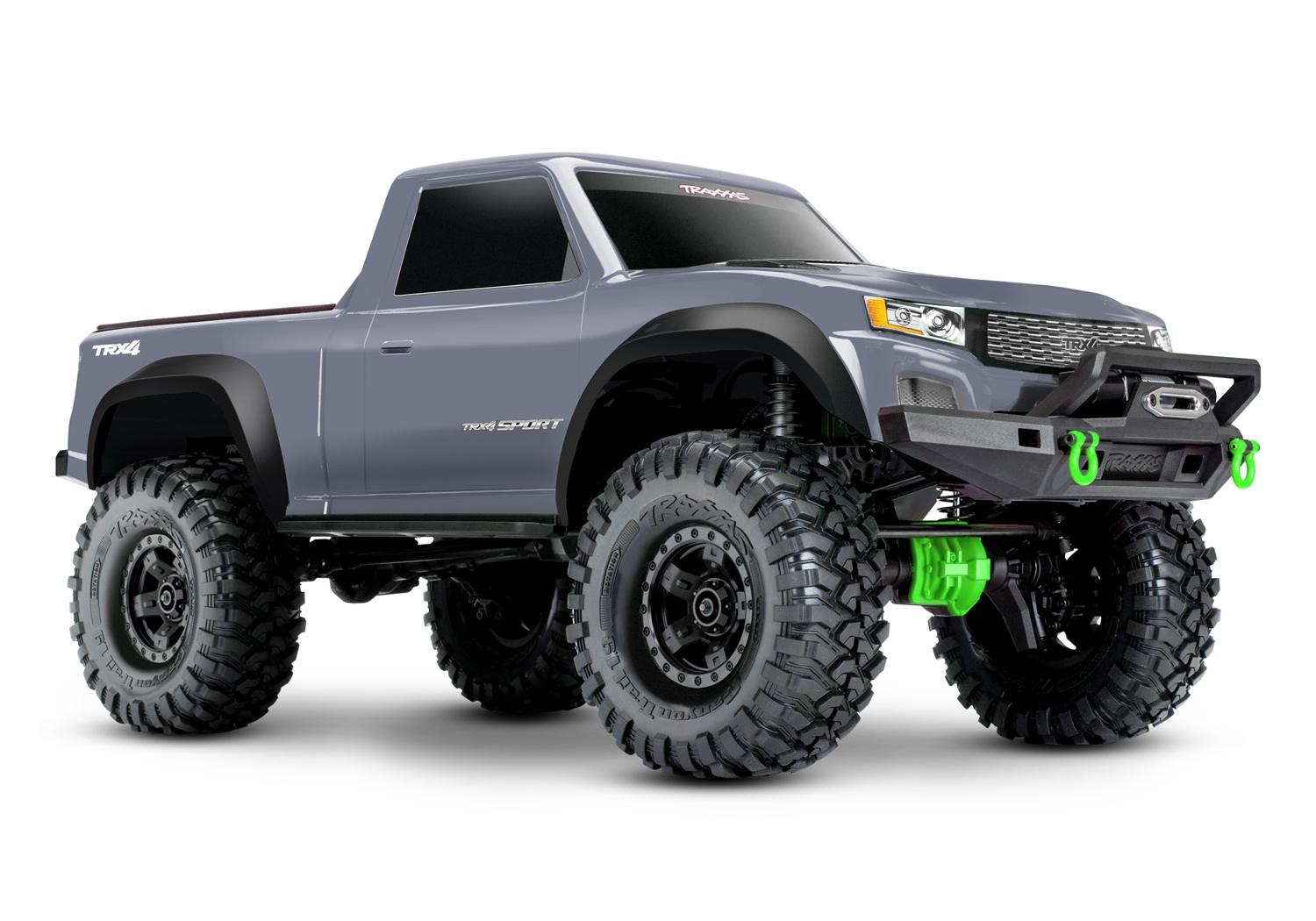
For deliberate rock placement and trail obstacles, the Traxxas TRX-4 Sport 82224-4 has a single-speed transmission, locked front and rear differentials and portal axles. The portals raise the axle housing relative to the wheels. That design addresses a crawling problem, while its activity differs from drifting and open-area bashing. Do not transfer the selectable differentials or two-speed transmission of some other TRX-4 versions to the Sport.
These examples explain categories rather than rank three competing purchases. A gravel fragment that is minor beside one truck may be substantial beside a small road car. A trail crawler can also be the wrong choice for someone whose definition of fun is fast, flowing laps. Choose the mechanism and the intended activity together, then read the complete package review before deciding what belongs in your garage.
| Complete vehicle | Documented equipment | Editorial terrain fit |
|---|---|---|
| Kyosho 32652ID · MINI-Z AWD Initial D R32 | Compact MA-020-N; supplied drift tires | Clean, smooth drift space; not a lawn solution |
| ARRMA ARA2304T1 · Mojave GROM 223S | 1/16 4WD desert truck; independent suspension | Clear compact off-road routes; assess roughness and vegetation |
| Traxxas 82224-4 · TRX-4 Sport | Portal axles; locked differentials; single speed | Deliberate trail and rock-crawling activity |
Sources: Kyosho exact 32652ID page · drift tires, chassis and physical dimensions ↗ · ARRMA / Horizon exact ARA2304T1 · complete desert truck and original equipment ↗ · Traxxas 82224-4 owner manual · portal design, driving limits, wet-operation restrictions and maintenance ↗ · ARRMA ARA2304 multilingual manual · dimensions, operating inspections and temperature protection ↗
A five-step check before the first run
Use this sequence to reject a poor venue early. It is a surface assessment, not permission to drive somewhere the vehicle manual excludes. Keep the initial configuration documented; changing tires, gearing and electronics together would make any result harder to interpret.
Walk the route and confirm permission
Look across the entire loop and its exit space. Identify pedestrians, pets, access routes, water and hard boundaries. Choose somewhere you can see and retrieve the car without entering traffic or damaging property. If the area is shared, wait or move. A venue with no dependable stopping space fails this check regardless of its surface.
Inspect the difficult patch at wheel level
Check grass density, roots, stones and transitions rather than only the nicest straight. Compare their physical size with the exact vehicle. For a car you already own, inspect clearance with power disconnected and the normal operating load installed according to its manual. Do not lift or force the suspension to invent a larger usable gap.
Read the relevant operating limits
Find the exact manual's terrain, battery, temperature and moisture restrictions. A waterproof component label does not establish permission for the whole system to run wet. This guide starts with dry ground; if the route is damp or muddy, resolve the installed equipment's specific restrictions before proceeding. Do not apply another model's water-care instructions by analogy.
Start on the easiest representative section
Use the supported learning configuration in the clear part of the venue. Begin with a short, restrained pass where movement remains free, with space to steer and stop. Do not drive into the difficult patch just to find a limit. If the car repeatedly drags, becomes obstructed or behaves abnormally, stop and reassess the route.
Inspect and record the result
Shut down and disconnect as specified before checking for trapped vegetation, stones or other obstruction. Keep clear of hot components and follow the actual manual's inspection and cooling instructions. Record the surface, conditions and any contact points. Choose a smoother or shorter-grass route if movement was restricted; do not treat a single successful pass as a durability test.
Sources: Traxxas support · overheating, load and inappropriate high-speed gearing; historical Rustler example ↗ · ARRMA ARA2304 multilingual manual · dimensions, operating inspections and temperature protection ↗ · Traxxas 82224-4 owner manual · portal design, driving limits, wet-operation restrictions and maintenance ↗
Common mistakes and what to check instead
When wheels turn but the chassis is supported by grass or a raised edge, first suspect the route and physical clearance. When movement changes suddenly after entering loose material, stop and inspect for obstruction using the shutdown procedure. When a car is slow everywhere, the surface alone is not a diagnosis: battery state, setup and mechanical condition need their own documented checks. These observations narrow questions; they do not identify a failed component by themselves.
Repeated thermal protection is a stop signal, not a normal lap timer. Use the exact model's troubleshooting guidance and resolve the cause before continuing. There is no universal temperature target, cooling period or gear change in this guide. Similarly, a rougher patch is not automatically solved by stronger stabilization. Assistance cannot remove stones or restore the clearance lost when the underside is sitting on the ground.
The useful result is a route where the car can move, steer and stop predictably within its documented use. Keep the surface notes alongside the model details, especially when choosing a second vehicle. A smaller smooth-surface car can be a sensible choice if the usable venue is indoors; a larger off-road model makes sense only when its activity and required space fit. Let the available driving decide the shortlist.
| Observation | Next check | Avoid |
|---|---|---|
| Chassis drags in grass | Shorter, sparser grass or another suitable route | Adding throttle to force progress |
| Sudden restriction after gravel | Power down; inspect per manual for obstruction | Reaching into powered wheels |
| Repeated thermal protection | Stop and follow exact-model troubleshooting | Repeatedly restarting without resolving the cause |
| Poor movement on every surface | Battery, settings and mechanical inspection | Assuming grass caused a specific broken part |
Sources: Traxxas support · overheating, load and inappropriate high-speed gearing; historical Rustler example ↗ · ARRMA ARA2304 multilingual manual · dimensions, operating inspections and temperature protection ↗ · Traxxas 82224-4 owner manual · portal design, driving limits, wet-operation restrictions and maintenance ↗
Your terrain-match checklist
- Venue permission and a clear route with turning and stopping space confirmed
- Surface density, typical obstacles and transitions inspected at wheel level
- Exact vehicle identified; actual dimensions and supplied tires checked
- Clearance distinguished from suspension travel and driven-wheel count
- Dry operating area chosen; any moisture restrictions resolved for the exact equipment
- No unresolved dragging, obstruction or abnormal operation during the restrained check
- Post-run inspection completed using the manual; route notes saved
Frequently asked questions
Can a 1/10 RC car run on any lawn?
No. Scale is not a grass capability rating. Compare the exact car’s tires, low components, operating limits and the height and density of the actual lawn. Tall or tangled grass can restrict even an off-road vehicle.
Does 4WD make an RC car suitable for grass?
It can help use available traction, but it cannot lift a chassis supported by grass or remove an obstruction. Clearance, tires, power-system load and manufacturer limits remain separate checks.
How much ground clearance do I need?
There is no single figure for every lawn or gravel path. Inspect the route and the actual loaded car, including low axle parts and body overhangs. A catalog clearance figure is not a guaranteed maximum obstacle height.
Can I fix grass bogging by fitting larger tires?
Do not assume an arbitrary larger tire is compatible. Tire clearance, steering, gearing and drivetrain load all matter. Choose a more suitable surface first and use exact-model manufacturer guidance for any change.
Can waterproof RC cars run on wet grass?
Check the whole installed system’s instructions, including battery and transmitter restrictions. For example, the current TRX-4 Sport 82224-4 manual prohibits LiPo batteries in wet conditions and says its transmitter is not water resistant. That rule should not be replaced with another model’s advertising.
Is the MINI-Z AWD Initial D R32 an off-road car?
Kyosho 32652ID is a compact MA-020-N Readyset supplied with drift tires. AWD describes its driven wheels; it does not change that drift-car purpose into a lawn or gravel-trail specification.
Sources and method
Research-led guide checked 16 October 2026. Exact manufacturer specifications and operating cautions support the explanations; the venue-selection sequence and category fit are editorial judgments. No physical terrain comparison, grass-height threshold, measured grip, speed, runtime or durability result is claimed. Historical gearing guidance is used only to explain load, without transferring tooth counts. No direct purchase links or prices are needed. The four-question diagram is original; the credited Traxxas photograph is existing official media.
- Horizon Hobby · vehicle finder, intended activities and surface categories ↗Manufacturer documentation · checked 16 Oct 2026
- Traxxas glossary · ground clearance and scale terminology ↗Manufacturer documentation · checked 16 Oct 2026
- Traxxas support · overheating, load and inappropriate high-speed gearing; historical Rustler example ↗Manufacturer documentation · checked 16 Oct 2026
- ARRMA ARA2304 multilingual manual · dimensions, operating inspections and temperature protection ↗Manufacturer documentation · checked 16 Oct 2026
- Traxxas Suspension Tuning Guide Part 2 · 10 December 2020 · ride height and suspension travel ↗Manufacturer documentation · checked 16 Oct 2026
- Kyosho exact 32652ID page · drift tires, chassis and physical dimensions ↗Manufacturer documentation · checked 16 Oct 2026
- ARRMA / Horizon exact ARA2304T1 · complete desert truck and original equipment ↗Manufacturer documentation · checked 16 Oct 2026
- Traxxas 82224-4 owner manual · portal design, driving limits, wet-operation restrictions and maintenance ↗Manufacturer documentation · checked 16 Oct 2026
- Traxxas exact 82224-4 page · locked differentials, single speed and official photograph ↗Manufacturer documentation · checked 16 Oct 2026
First published 16 October 2026. Exact-model dimensions, original equipment, terrain cautions and sources checked for this edition.